Dewey’s obsession with the Clutter case and resulting exhaustion
In Cold BloodDewey’s obsession with the Clutter case and resulting exhaustion became a force that reached beyond his work as an investigator: it altered his family’s routines, crowded out ordinary concerns, and left him physically depleted. His determination to discover what had happened to the Clutters was bound both to the unanswered case and to a growing sense that he had come to know the victims intimately. The investigation promised a connection somewhere in the past; until he found it, neither his attention nor his household could return to normal.
The investigation takes over
As Christmas approached, Dewey sat caught in Saturday traffic on Main Street, beneath holly garlands and scarlet paper bells. The season brought into view a domestic task he had neglected: he had not bought a gift for Marie Dewey or their sons. Yet his mind rejected problems unrelated to the case. That narrowing of attention was visible to people around him. Marie and their friends had begun to wonder at how completely it occupied him, and his friend Clifford R. Hope, Jr., told him plainly that he seemed to talk about nothing else.
Dewey did not deny the fixation. He explained that talking might bring a new angle to light, whether from his own thinking or someone else’s. He also feared that if the case remained open, it would continue to claim his attention years later: each new murder that resembled it, even remotely, might send him back to checking for a connection. The possibility of an indefinitely unresolved investigation was one burden, but not the only one. He felt that he knew Herbert W. Clutter and the family better than they had known themselves, and said that they haunted him until he knew what had happened.
The case also shaped the way Dewey approached investigation. Speculation about details at the crime scene might absorb him, but it could not satisfy him as progress. He put his faith in facts that had to be gathered and checked, and described the task to his team as learning the Clutters so thoroughly that they could connect what had been found after the killings to something perhaps five years earlier. That pursuit meant tracking former River Valley Farm employees, friends, relatives, and business associates. The search was deliberately expansive: the hoped-for link might lie far back in the victims’ lives, beyond the immediate crime scene.
The case enters the home
The investigation’s pressure was not confined to Dewey’s thoughts. His household heard the telephone repeatedly and encountered strangers at the door; his sons also saw their father’s worry. One morning Paul, ordinarily occupied with backyard tunnels or trying to become the fastest runner in Finney County, burst into tears. He understood only vaguely why the house was unsettled, but his mother recognized that the commotion made him feel endangered. Paul’s older brother tried to comfort him by offering to teach him poker the next day.
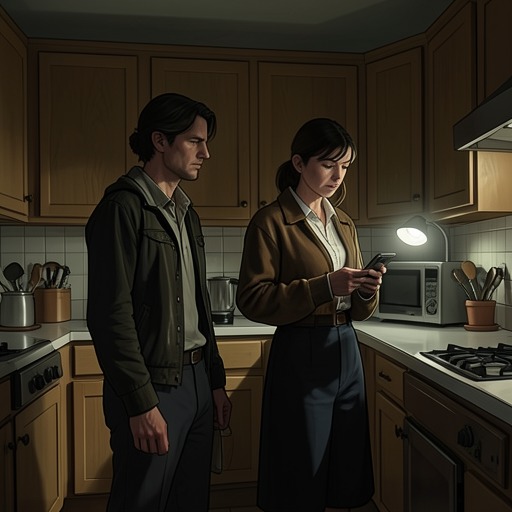
Marie’s response to the case carried a different cost. She found Dewey in the kitchen beside a pot of coffee, with crime-scene photographs spread across the table and dark stains laid over its fruit-patterned oilcloth. He had once offered to show her the photographs, but she declined because she wanted to remember Bonnie Clutter and the others as they had been. The photographs made the investigation physically present in a shared domestic space, while Marie’s refusal marked a boundary between the work of investigating the deaths and her own memory of the people who had died.
Dewey considered sending the boys to stay for a few days with his widowed mother, who lived nearby and welcomed her grandchildren, though she found her house too spacious and silent. The suggestion was tentative, and its endpoint remained undefined: he could only imagine the arrangement lasting until the present upheaval had passed. Marie’s question about whether they would ever return to normal living gave that uncertainty a direct domestic expression. The case had disturbed not only their schedule but their confidence that ordinary family life would resume on its own.
Ordinary life displaced
The contrast was sharp because the Deweys’ normal life depended on shared, practical routines. Both adults worked; Marie was an office secretary, and they divided household chores, taking turns cooking and washing dishes. When Dewey had been sheriff, colleagues teased him about putting aside his gun and putting on an apron at home. The joke depended on a familiar passage between public duty and domestic labor, a balance the case was now eroding.
They were also saving to build a house on a farm Dewey had bought in 1951: 240 acres several miles north of Garden City. In good weather, especially when the wheat was high and ripe, he liked to drive there, practice drawing his gun, and imagine the house and garden he hoped to make. He pictured oaks and elms growing on the open plains. These plans gave their ordinary future a particular shape—land, a home, and trees that had not yet been planted. Against that anticipated life, the unresolved case kept pulling Dewey back toward the past.
Even small errands showed how difficult it had become for him to keep both worlds in view. Marie had asked him to collect Courthouse Pete, the family’s fifteen-pound, tiger-striped tomcat, from Dr. I. E. Dale’s veterinary office. Dewey remembered only after leaving the shopping traffic and driving toward Holcomb. The cat had been hospitalized after losing a fight with a boxer dog and needed stitches and antibiotics; once released, he rode in the front seat and purred on the way. The episode shows Dewey’s distraction through a concrete lapse, but also preserves a thread of ordinary care: amid the murder investigation, he still completed the errand for his family.
Physical cost and unfinished work
By the time a café waitress remarked on his appearance, Dewey had lost twenty pounds in three weeks. His suits hung on him as though borrowed from a larger man, and he answered that he felt fine even as she told him he looked awful. The discrepancy between his assurance and visible weight loss makes the bodily cost of the case difficult to dismiss. The strain was not his alone: the Kansas Bureau of Investigation team around him was tired, and Harold Nye continued reporting for duty while sick with flu and fever.
Together, the four investigators had checked about seven hundred tips and rumors. The scale of that work clarifies why Dewey could not simply set the case aside: each lead demanded verification, even when it led nowhere. He had spent two wearying days trying to trace a pair of Mexicans whom Paul Helm had insisted visited Herbert W. Clutter on the eve of the murders. The reported visitors proved to be a phantom lead, consuming time without resolving the mystery. For Dewey, however, exhaustion and dead ends did not lessen the obligation to keep searching. His family’s disrupted routines, his neglected errands, his weight loss, and the investigators’ accumulated fatigue all register the same unresolved condition: until he could explain the Clutters’ deaths, the case remained present in both his working life and his home.